
CMH and the warranty conversation
A skid-steer engine fails. The owner’s records say 1,840 hours. The manufacturer’s warranty covers it to 2,000. The claim should be straightforward.
It’s not. The manufacturer’s adjuster asks: how do you know it was 1,840 hours? What measured them? Who’s signed off on the data? When was the hour meter last calibrated? Is there any evidence the meter was tampered with or the engine was swapped?
If the answer to any of those is “we wrote it on a clipboard,” the claim is now an argument.
What manufacturers actually accept
We’ve sat through enough warranty disputes to have a working sense of what gets accepted as evidence of operating hours. In rough order of weight:
- Manufacturer’s own telemetry — CAN-bus integrated, factory-fitted hour meter. The strongest evidence. The manufacturer trusts it because they wrote it. Almost impossible to dispute.
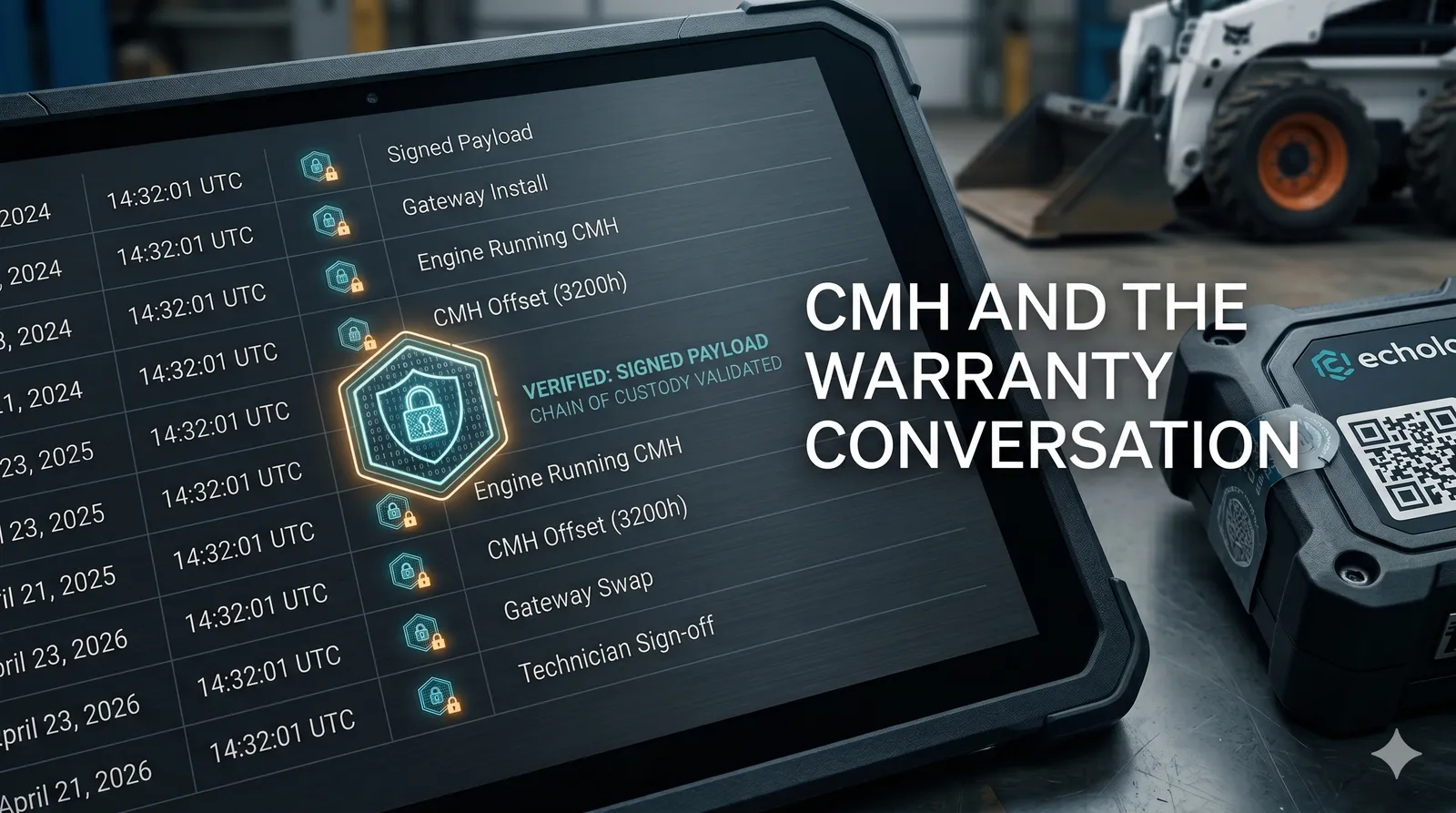
- Third-party telemetry with signed payloads, continuous timestamps, and a documented installation date. This is what we ship. The chain of custody matters as much as the number — the adjuster wants to know the data wasn’t edited, that the gateway hasn’t been swapped without bookkeeping, and that there’s a continuous timeline from install to failure.
- Operator-maintained logbooks countersigned by a supervisor. Acceptable but disputable. Adjusters apply a discount if the logbook is the only evidence.
- Operator-maintained logbooks, no countersignature. Often disregarded entirely.
- A photograph of the on-board hour meter at the time of failure. Used to corroborate other evidence; rarely sufficient on its own.
If your only evidence is in category 3 or below, you’re negotiating, not claiming. Warranty terms get interpreted broadly when the data is good and narrowly when it isn’t.
Signed payloads, timestamps, chain of custody
The boring details that make telemetry hold up in a dispute:
- Each beacon is signed at the gateway. Not just transport-encrypted; signed with a per-gateway key so the payload’s origin can be verified independently of the network it traveled over.
- Timestamps are NTP-synced and recorded at both the gateway and the broker. Skew between the two is logged. If they drift more than a couple of seconds, that’s flagged as a data-integrity event.
- Gateway swaps are recorded as explicit events. A new gateway on an existing asset gets logged with timestamp, technician, and a CMH offset entered against the on-board meter at the moment of swap. The audit trail says “from this timestamp forward, the data is from a different physical device, and here’s the bookkeeping that ties them together.”
- Engine swaps are recorded against the engine, not the chassis. Hours follow the engine. The chassis can have its own clock.
- Raw data is append-only. We never overwrite a CMH reading. Corrections are stored as adjustment entries with a reason, not as edits to the original record.
None of this is glamorous. All of it is the difference between a one-page warranty claim and a six-month dispute.
Where we’ve seen claims fail
Three patterns, in descending order of frequency:
- Install-time offset never recorded. Customer installed our gateway when the on-board meter read 3,200 hours. Never wrote it down. Two years later, the dashboard says 4,800. The on-board says 8,000. Manufacturer asks: what was the meter at install? Nobody knows. The dispute goes to arbitration.
- Gateway swapped without an event record. Hardware fault, replacement gateway, no swap event in the audit log. The data shows a “new device” appearing on day 487 with no continuity to the previous one. The adjuster treats hours zero through 487 as unverified.
- Engine swap with chassis-level CMH. The engine was replaced at 6,000 chassis hours. The next failure was at “8,200 hours” on the dashboard, but only 2,200 on the replacement engine. The warranty applies to the engine; the dashboard reported the chassis. Long argument.
All three are bookkeeping failures, not technology failures. The telemetry was working. The records around it weren’t.
What Fleet exports for a warranty dispute
When a customer asks for a warranty packet, Fleet generates a PDF with:
- The asset’s full CMH timeline from install to failure.
- Every gateway and engine swap event, with timestamps and technician sign-off.
- A per-day CMH summary so the manufacturer can audit any specific date.
- The signed-payload verification status for every beacon used in the calculation.
- A statement of the CMH definition in use — engine-running, ignition-on, or other — with the rationale.
- A copy of the install-time offset, with the technician and timestamp who recorded it.
It’s not pretty. It’s auditable. The two times we’ve shipped one to an adjuster, the claim was paid without further dispute.
The takeaway
CMH is a measurement. A warranty claim is an argument about the measurement. The argument is won or lost on the bookkeeping around the data, not the data itself.
If your CMH process can’t answer “who installed this, when, against what on-board reading, signed by whom, with what swap events in between” — it’s not warranty-grade, no matter how precise the dashboard looks.