
Solar and battery sizing for remote sites: the math nobody does
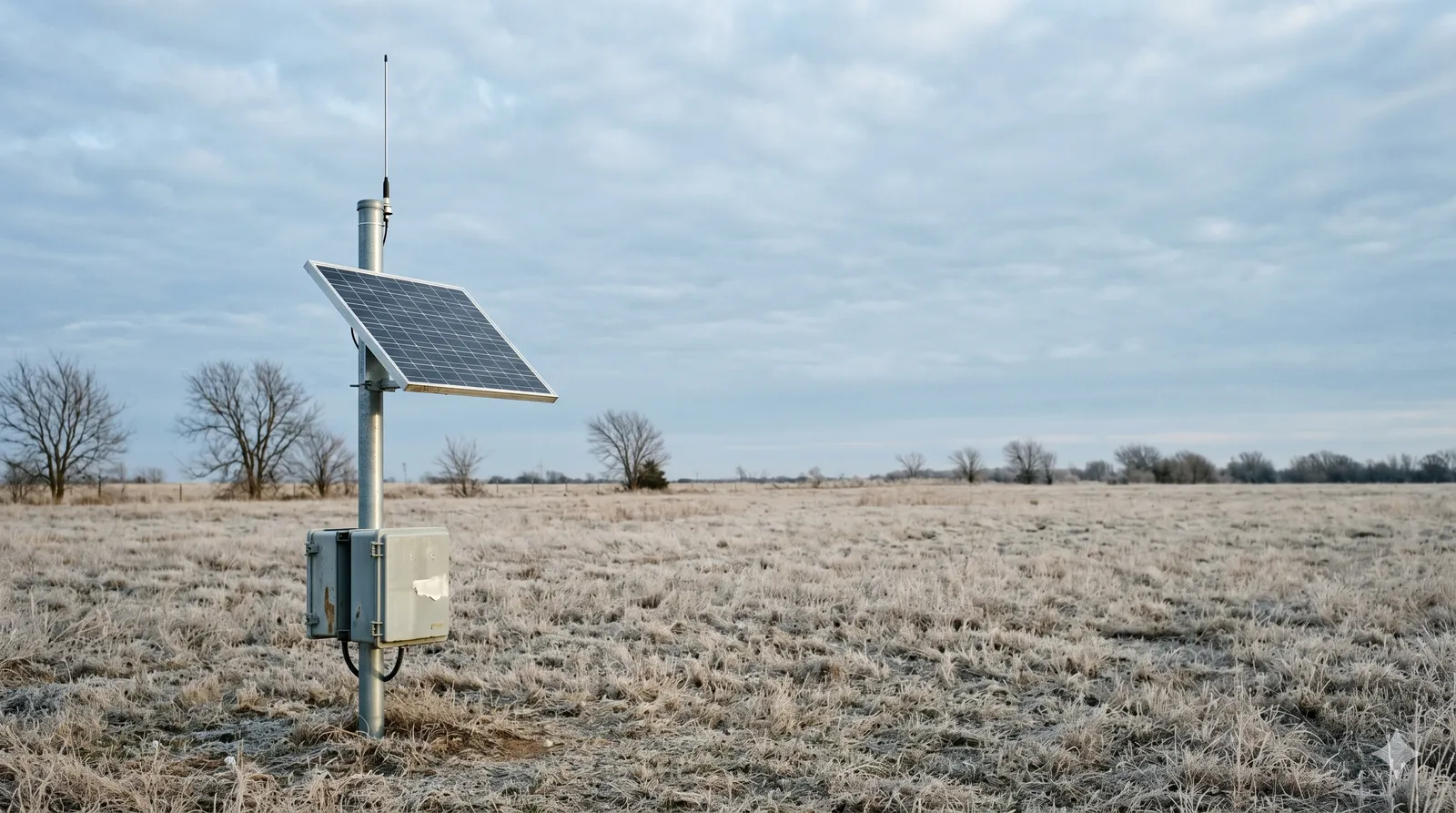
The phrase “we’ll just put a solar panel on it” has cost more deployments than any single failure mode we’ve seen. Solar plus battery sounds simple — panel charges battery, battery powers gateway, sun comes up tomorrow. It works fine in May. It does not work in February, and February is when the customer notices.
Here’s the math we actually run before we quote an off-grid install.
Start with load, not panels
Sizing a power system from the panel down is backwards. Start at the load.
For a typical Echolo gateway install with cellular backhaul and a LoRa concentrator, we measure — not estimate, measure — the steady-state current draw on the bench:
- Cellular router (idle, occasional transmit): ~6–8W
- LoRa gateway: ~4–6W
- PoE camera, if present: ~5–8W per camera
- Switch and miscellaneous: ~2–3W
Real-world budget for a “small” remote site: 15–25W continuous. With a camera or two, 25–40W. People consistently underestimate this by half because they’re looking at the “typical” line on a datasheet, not the “transmitting plus charging plus margin” reality.
Multiply by 24 to get daily watt-hours. A 25W continuous load is 600 Wh/day. Hold that number.
Days of autonomy: the number that decides everything
How many days can the system run without any sun? This is the single most important parameter and the one most often skipped.
Our defaults:
- Sunny climates (Arizona, Texas, southern California): 3 days of autonomy
- Mixed climates (most of the continental US): 5 days
- Cloudy or northern climates (Pacific Northwest, Great Lakes, New England): 7 days minimum
- Anywhere with real winter: add 2 days on top of the climate baseline
Three days at 600 Wh/day is 1,800 Wh of usable battery capacity. That’s the load on the battery side.
Battery sizing: depth of discharge is not optional
Usable capacity is not the same as nameplate capacity. You have to derate for:
- Depth of discharge. LFP can go to 80–90% safely; SLA tops out around 50% if you want it to last more than a season. We size for 80% DoD on LFP, 50% on SLA.
- Temperature. A battery rated at 25°C loses 20–30% of its usable capacity at 0°C. If the enclosure isn’t heated, factor it in.
- Aging. A battery at year three is at 80% of its year-zero capacity. Size for end-of-life, not new-out-of-box.
That 1,800 Wh requirement, on LFP, with cold weather and aging factored in, becomes roughly 3,000 Wh of nameplate battery — a 100Ah 24V bank, or two 100Ah 12V batteries in series.
If somebody quotes you a 50Ah battery for a 25W continuous load with five days of autonomy, they have not done the math.
Solar sizing: peak sun hours, by month
Solar output isn’t an annual average. It’s a monthly curve, and the month that decides the system size is December.
We use NREL’s PVWatts data for the specific lat/lon of the install, pulling the worst month’s average peak sun hours. A few real numbers:
- Phoenix, AZ: ~5.5 peak sun hours in December
- Atlanta, GA: ~3.5
- Chicago, IL: ~2.0
- Seattle, WA: ~1.2
Then derate for panel soiling, wiring losses, charge controller efficiency, and panel temperature. A reasonable end-to-end derate is 0.7 — meaning a 100W panel gives you about 70W under good sun.
For our 600 Wh/day load in Chicago: 600 / (2.0 × 0.7) = ~430W of panel to break even in the worst month. Round up to 500W and add headroom for the days when the worst-month average doesn’t show up.
In Phoenix the same load needs ~155W of panel. The same hardware in two climates needs three to four times the panel.
Charge controller: MPPT, sized for the panel
Cheap PWM controllers leave 20–30% of your panel output on the floor in cold weather. For any install above ~100W of panel, MPPT is mandatory, not a nice-to-have. Size the controller’s input voltage and current rating to the panel array with margin — panels in cold sun produce more voltage than their nameplate, and a controller that clamps loses you the headroom you paid for.
The cold-weather problem nobody mentions
LFP batteries cannot be charged below 0°C without permanent damage. Most off-grid IoT enclosures sit outside. In any climate that gets a real winter, you need either:
- A battery with a built-in low-temperature charge cutoff (the controller stops charging below 0°C — your battery survives, but it doesn’t charge until it warms up), or
- A heated enclosure with a thermostatically-controlled pad warmer (uses power, but keeps the battery in its operating range)
We default to the cutoff for sites that see occasional freezes. We default to the heated enclosure for sites that spend weeks below freezing. The wrong choice destroys a battery in one winter.
Mounting, angle, and the things that go wrong
The boring details that dominate real-world performance:
- Tilt angle = latitude + 15° for winter-optimized installs. The summer hit is small; the winter gain is large.
- Clearance from snow. A panel buried in snow produces zero. Mount high enough that the worst snowfall in the site’s history doesn’t bury it.
- Vegetation. Trees grow. The clear shot to south you have today will be 40% shaded in three years if there’s a fast-growing pine nearby.
- Cleaning access. Someone will need to wipe pollen, dust, or bird droppings off this panel. If the only way to reach it is a 30-foot ladder, plan for that to never happen.
- Cable runs. Long DC runs at low voltage lose a lot of power. We size the cable for less than 3% loss between panel and controller, and we measure — not estimate — the resistance after install.
A worked example
Remote agricultural site outside Des Moines, IA. Gateway plus cellular router plus one PoE camera. Measured load: 28W continuous, 672 Wh/day.
- December peak sun hours: ~2.2
- Required panel (with 0.7 derate): 672 / (2.2 × 0.7) ≈ 435W. Specify 500W.
- Days of autonomy (mixed-cold climate, +winter buffer): 7 days. 7 × 672 = 4,700 Wh.
- LFP at 80% DoD, cold-derated: 4,700 / 0.8 / 0.8 ≈ 7,350 Wh. Specify a 24V 300Ah bank.
- MPPT charge controller, 40A rating, with low-temp cutoff.
- Heated enclosure (LFP, Iowa, no compromise).
That’s not a “couple of panels and a deep-cycle.” It’s a real power system. It’s what survives February.
What we wouldn’t build again
- Undersized “starter” systems with the promise to expand later. Customers don’t expand. They live with the brownouts and call us in March.
- AGM or flooded lead-acid for any new install. LFP is more expensive up front and dramatically cheaper over five years.
- A single panel, single battery, no margin. One bird, one tree branch, one bad cell, and the site is dark. Size for redundancy, or budget for site visits.
- No remote monitoring of the power system itself. The gateway watches the equipment. Something needs to watch the gateway’s battery voltage and panel current. If the power system is silently dying, you want to know before the radio goes off the air.
The math takes an hour. The hardware costs what it costs. Skipping the math costs a winter.