
You don't have a 40-machine fleet
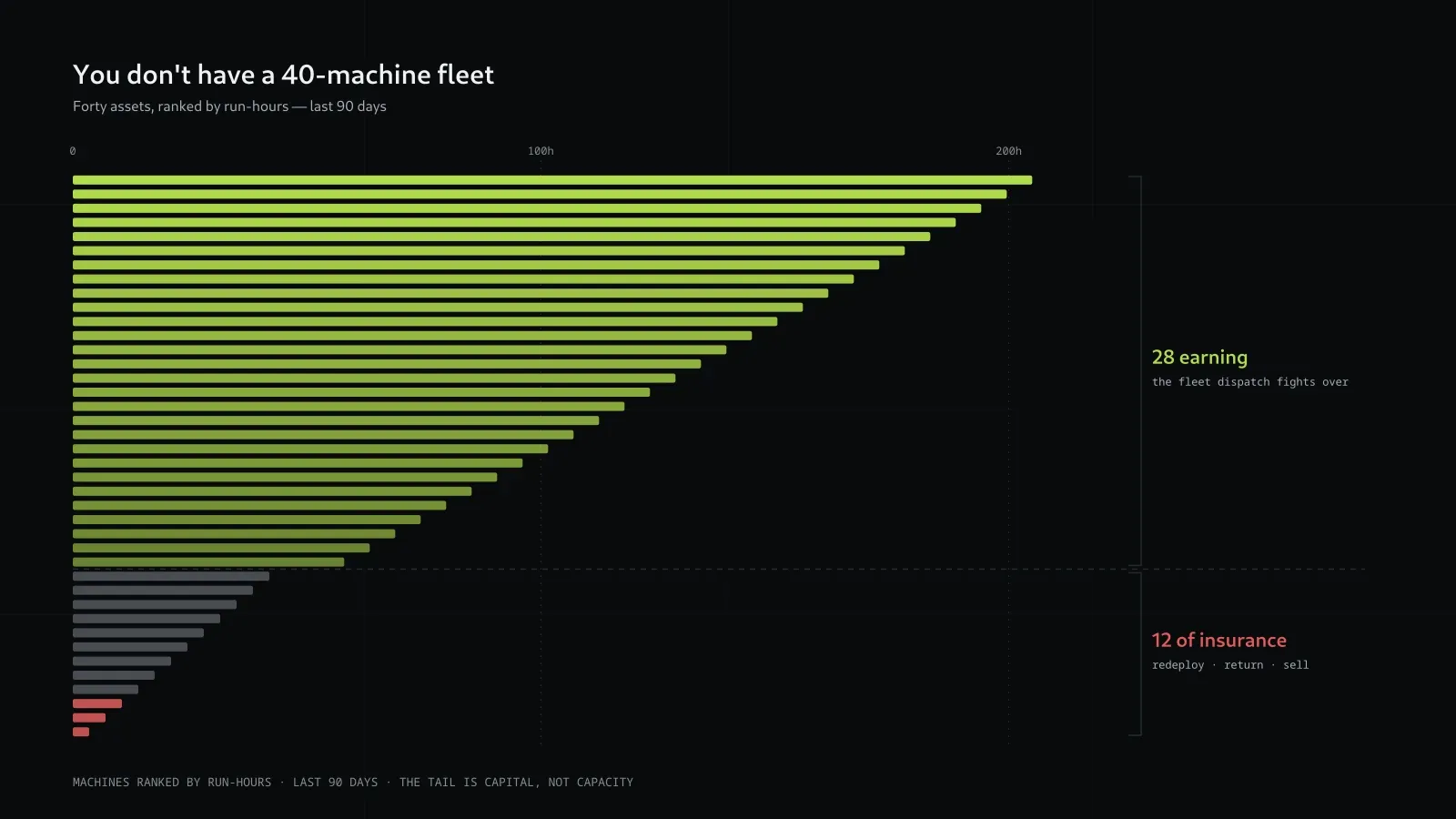
Count the machines on your asset list. Say it comes to forty. Now count the ones that turned an engine over last week. That’s a different number, and it’s almost always smaller — usually by more than anyone in the yard wants to say out loud.
The gap between those two numbers is the most expensive thing most fleets never measure. You’re insuring, storing, depreciating, and inspecting forty machines. You’re getting the work of twenty-eight. The other twelve aren’t a fleet. They’re capital, parked.
The tail is longer than you think
Rank every asset by hours run over the last ninety days and you don’t get a flat line. You get a curve. A handful of machines are pinned near the top — the ones dispatch fights over. A broad middle does steady, unremarkable work. And then a tail: machines that ran a few hours, or none, across the whole quarter.
Everyone knows the tail exists. What they don’t have is its length, by name, with a number attached. “We’ve got a few that don’t get used much” is a shrug. “Here are the assets that logged under twenty hours in ninety days, by unit number” is a decision waiting to be made.
Idle iron is a decision — you just made it by not looking
A machine that sits isn’t free. It’s holding its share of the insurance premium, a spot on the lot, a line on the depreciation schedule, and a slot in the inspection rotation. If it’s financed, it’s holding a payment. None of that pauses because the machine did.
So every low-utilization asset is really a standing decision to keep paying to own it instead of doing something else. That decision might be right. But on most fleets, nobody’s making it on purpose — it’s the default that happens when no one has the hours in front of them.
What the number actually changes
Trustworthy per-asset hours turn the tail from a vague unease into a short list of moves:
- Redeploy before you buy. The most common one. A branch is about to sign a PO for another skid steer while two sit at ninety hours a year across town. The hours make the transfer obvious — and kill the purchase.
- Return what you’re renting to yourself. Owned machines that idle are the same problem as a rental you forgot to send back, minus the invoice that would have reminded you. The return-day argument is easier when it’s your own iron and the meter is honest.
- Sell the genuine dead weight. Some of the tail isn’t waiting for work — it’s done. Hours-since-forever plus a resale value is the whole case for auctioning it, and CMH is the number that survives a buyer’s scrutiny.
- Right-size the next order. When the tail is measured, “we need four more” quietly becomes “we need one more and a redeploy” — the sentence that pays for the whole tracking program in a quarter.
The catch: it only works if you can count the hard assets
Here’s where most fleets get stuck. The machines with an engine computer report their hours all day — trucks, late-model big iron, anything with a bus to read. Those were never the problem.
The tail is full of the other kind. Compressors, light towers, gensets, pumps, non-powered attachments, the aging machine nobody telematized because it wasn’t worth a cellular plan. That equipment has no bus and often no steady power — and it’s exactly the stuff that quietly idles, because nothing was ever counting its hours to tell you otherwise.
Which is the whole reason we put the hour-counting on the tag instead of the map. An accelerometer feels the machine run, the tag accumulates the total on-device, and a coin cell rides it for years. No SIM per asset, no wiring into the OEM harness. You get run-hours on the un-telematized half of the yard — the half where the idle capital actually hides.
Where the tail is supposed to sit still
Now the honesty, because this argument has a failure mode. Low utilization is not automatically waste. Some machines are supposed to sit.
The backup generator that runs four hours a year is doing its job by being ready. The fire pump, the spare that covers a breakdown during peak season, the specialized attachment you use twice a year but can’t rent on a day’s notice — those earn their keep as insurance, and the run-hours will always call them slackers. A utilization number is an input to the decision, not the decision itself.
That’s the shift. Not “cut everything that’s idle” — that’s how you end up renting a generator at 2x during an outage you owned the machine for. It’s “know the tail by name, so the machines that sit are the ones you chose to have sitting,” and you can tell the deliberate standby apart from the accidental.
Forty on paper, twenty-eight at work
The fleet on your asset list is a count of what you own. The fleet in your utilization data is a picture of what you use. When those two disagree — and they always do — the difference is money you can move: a purchase you don’t make, a rental you send back, a machine you sell, a transfer that covers a branch that was about to buy.
You can’t manage that gap until you can see it, and you can’t see it until you’re counting hours on every asset — not just the ones that came with a port. What you even mean by an hour is its own discipline, and idling isn’t working — but “we have no hours at all on half the fleet” is the harder problem, and it’s the one the tail hides in.
If half your fleet can’t tell you its hours, that’s the half we’re built for — and the tail is usually where the first quarter’s savings are waiting.