
The machine that left at 2am
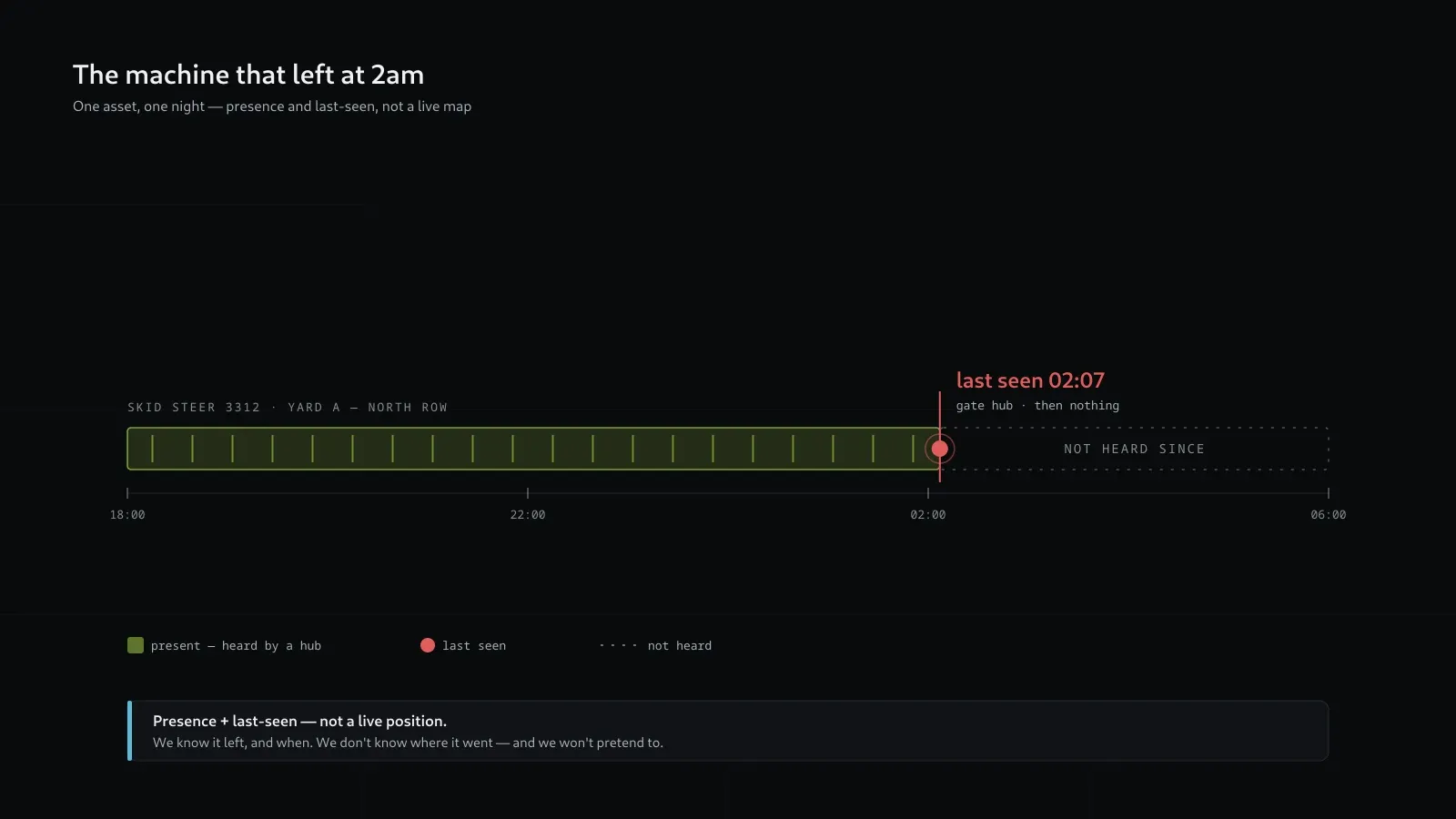
The skid steer was in the north row at close on Friday. On Monday it wasn’t. Somewhere in between it left, and the first anyone knew was a gap on the lot where it used to be.
Here’s what we’re not going to tell you: that we’d have painted a live dot chasing it down the interstate. We wouldn’t have. But we’d have shown you something, and it’s a great deal more useful than an empty parking spot and a Monday guess.
Presence is a heartbeat; absence is information
A tag broadcasts. A hub hears it — a fixed hub on the fence, or a crew member’s phone walking the yard. Every few minutes, still here. It’s the least dramatic data in the system. A machine that’s present just keeps being present, quietly, for months.
Until it doesn’t. The value isn’t in the heartbeat — it’s in the moment the heartbeat stops on a machine that had no business leaving. Friday 6pm: heard at the north row. 2:07am: heard once at the gate. 2:11am: nothing, and nothing since. That’s not noise. That’s the timeline of a departure, recorded by hardware you put out to count hours, not to run security.
Last-seen is a fact. Live position is a guess we won’t sell you.
This is the line we don’t cross, and it matters. “Last seen at the gate hub, 2:07am” is a fact — a hub heard the tag, then didn’t. “The machine is currently at 5th and Main” is not something a Bluetooth tag can tell you, and we’re not going to imply it can. The tag has no GPS and no cellular radio. Out of earshot of every hub, it goes silent. We know it left. We do not know where it went.
That’s the same discipline we hold everywhere: presence isn’t a live map. A last-seen record answers when did it go, and where was it last heard. It does not answer where is it now — and a system that pretends otherwise is selling you a dot it made up.
You already have the net
The reason this is worth mentioning at all: it costs nothing extra. If you tagged the yard to get hours off the un-telematized iron, every one of those tags is already broadcasting. If your crew runs Fleet on their phones, every phone is a hub — a roaming one that hears tags as it moves, and keeps checking in periodically if background scanning is switched on. The same fabric you deployed for utilization is, for free, a net that registers when something stops being heard.
Nobody buys four hundred GPS trackers to catch the one machine that walks — the math never works. But presence and last-seen you already own, as a byproduct of counting hours. So the departure signal comes along at no additional cost, across the whole fleet, including the machines too old or too cheap to ever justify a cellular tag.
What it catches — and what it honestly doesn’t
Be clear-eyed about the boundary. Presence and last-seen catch:
- The after-hours departure. Something moved while the yard was closed, and there’s a timestamp and a last hub instead of a shrug.
- The slow drift. An attachment that “walked” to another branch turns up present at the wrong yard — not stolen, just quietly misplaced, which is the far more common story.
- The “it was here Tuesday” dispute. A last-seen history settles where a machine was, and when, without anyone’s memory being the evidence.
What it does not do, and we won’t dress it up:
- It won’t recover the machine. It tells you it’s gone, and roughly when. Acting on that is a call to the police with a last-known time, not a live pin you follow down the highway.
- It won’t track it off your sites. Out of hub range, the tag is silent. No breadcrumb trail across three counties.
- It isn’t a substitute for a GPS-and-cellular tracker where you genuinely need live position — high-theft gear, over-the-road assets. If that’s the job, buy the right tool, and we’ll tell you so.
The honest version is still worth having
A live-tracking pitch is easy to make and hard to keep. The honest one is smaller and true: the tags and phones you deployed to count hours also keep a quiet record of who was heard, where, and when. The night a machine leaves that shouldn’t, that record turns an empty spot and a guess into a timeline you can act on.
It won’t chase the machine for you. But it’ll tell you it went, and when, and where it was last heard — which is a great deal more than the lot full of nothing you’d have had otherwise. And it comes free with counting the hours you were already going to count.
If you’ve got a yard full of assets and no idea which of them were heard from last night, that’s the fabric we build — and the hours are the reason to put it out in the first place.